It’s a commonly accepted and often repeated concept.
It’s illustrated by powerful examples from Bill Gates, Steve Jobs, and Mark Zuckerberg to Frank Lloyd Wright and Buckminster Fuller to James Cameron and Tom Hanks (every one of them is a college dropout).
It’s the sub-headline and positioning of a recent “Billionaire University” story in the Forbes 30 Under 30 issue: “Some of the Forbes 400 have Ph.D.s; far more never finished college.”
The Concept: College is unnecessary if you want to get rich. The best school is the school of hard knocks. The lecture hall pales in value to life experience. Learning means doing.
The concept is true. College is not absolutely necessary. High school grads and college dropouts do populate the Forbes 400 (the 400 richest Americans).
While I concede that it’s true, it’s also misleading, as is the positioning of the Billionaire University piece (comparison of college dropouts to a narrow segment of advanced degree holders).
The Chart: Using data published in the Forbes story and adding a couple observations, I produced this chart …
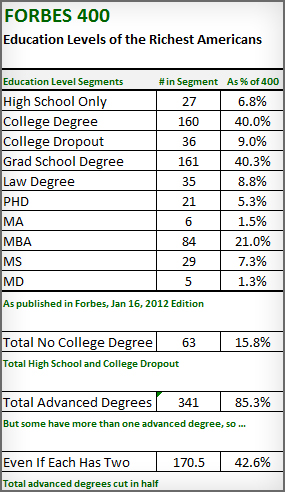
Education Levels of the Forbes 400 - the Richest People in the United States
Observations:
- Yes, there are high school grads and college dropouts among the 400. They represent 15.8% of the group.
- Yes, there are many more college dropouts than PhDs – by a ratio just shy of 2:1.
- But, there are 341 total advanced degrees. If each person only had one, that would represent more than 85% of the 400.
- Even assuming that each person with an advanced degree held two of those 341, that leaves 170 of them with advanced degrees. That’s more than 42% of the 400 and nearly five times more than college dropouts.
- There are more than twice as many MBAs in the Forbes 400 than there are college dropouts.
My Interest:
I’ve been in the MBA program at the Seidman College of Business at Grand Valley State University. I’ve been in the MMA program at Aquinas College. I’m nearing completion of the AACSB-accredited MBA program at the University of Colorado – Colorado Springs.
I’ve invested significant time and money in these programs. I’ve learned a ton. I’ve met many interesting people and built some valuable relationships.
Still, I often find myself in a defensive position about this investment.
In addition, I’m skeptical and cynical by nature, so I quickly attached to the idea that the real numbers belie the popular concept.
[UPDATE] Click here for the 2017 update on the education levels of the Forbes 400 Richest Americans
Final Thoughts:
The Forbes 400 does not represent the U.S. population at large. The numbers, percentages, and ratios are likely very different at different levels of wealth.
I think the misleading positioning of Billionaire University is used to advance a romantic notion of the American entrepreneur. I do like that notion; I recognize its truth and cultural value. My point in this post is that it’s overstated.
From the perspective of the college-is-worthless/life-experience-is-the-best-teacher concept, Josh Kaufman produces an excellent content stream called The Personal MBA. I highly recommend it.
There’s a significant difference between college is unnecessary and college is worthless.
I don’t have any specific reason to complete my MBA. It’s just fun, interesting, challenging, and productive.
I recognize that all my graduate school costs are sunk costs at this point.
I also recognize the opportunity costs of the time and money invested in graduate school.
Wealth is nice, but it has absolutely nothing to do with being a good human.

Ethan- This is great, I shared everywhere and posted a link on my website. As an Independent College Counselor with Selective College Acceptance Counseling, I am always fighting the myth of the successful dropout. Most talent and skills need to be developed to their fullest in order to reach full potential. College is nothing more than the opportunity to expand your worldview and nurture your own innate abilities. This is the foundation of success!
Ethan, I enjoyed your article. But I would like to know the significance of getting a bachelor or higher degree to these wealthy top 40. In other words, how many of them got the higher education after they were wealthy or before. In my opinion, I think that getting a higher education degree has little to nothing to do with gaining wealth. I agree with Robert Kyosoki on that.
For some, the degree might be a necessary requirement – a basic qualification demanded by a company, industry, or opportunity. To my mind and from my experience and perspective, the degree is more about the journey than the destination – the people you meet, the concepts you develop, etc.
As for the wealthy, it’s practically an obligation. It’s also a networking opportunity.
Hi Ethan,
I just saw that the article is over two years old but maybe you’ll read this anyway. What people often forget in the whole college dropout billionaire discussion is a simple fact of conditional probability:
Yes, if you are a billionaire, the probability that you dropped out of college is 9%. In other words: P(dropout|billionaire)=0.09. But that is not equal to the probability P(billionaire|dropout) i.e. given that you drop out, what is the probability you’ll become a millionaire. Assuming for a moment that it was completely random who would become a billionaire then you would in fact be 14 times more likely to become one given that you have an MBA compared to that you are a college dropout. This is due to the fact that there are way more college dropouts than MBA graduates. (This is based on that there are 640K college dropouts per year and 100K awarded MBAs per year which I roughly gathered from a few sources.)
Thanks so much for giving this a read and for sharing such a thoughtful comment. Your flip on dropout|billionaire and billionaire|dropout is dead on.
Ethan,
Great post. I was just discussing these statistics with some colleagues of mine and an interesting option came up. What number of those billionaires were dropouts, became rich and then went back to finish their degrees? Was there anyone in your analysis that fit this profile?
Sorry for my post being two years later 🙂
Regards.
Hey, Steve! I appreciate you checking out this post years later and leaving a comment. My analysis was very shallow – just worked with the details provided in Forbes.
Your going back question is interesting; I do wonder how many are in the list that fit that profile. My guess is a couple/few. Returning to pick up a diploma after earning billions makes me think of, maybe, an NBA player or actor picking up an honorary degree and giving a speech.
Anyway, I may give that a go on a refresh of this piece. I think Forbes publishes that list every year.
Thanks again, Steve!